

The internet is awash with information on using artificial intelligence (AI) for social media. But an AI policy isn’t enough. Every business need to decide what ‘good use of AI in social media’ looks like for their organisation. And that means defining clear standards.
Common ways of working are forming, slowly
The use of AI by social media teams is now commonplace. From planning campaigns and creating content, to supporting approvals and streamlining measurement, there are so many opportunities to put the technology to work. To use AI appropriately, most businesses have – or are beginning to – establish AI governance in the form of guiding policies, procedures and principles for company posts.

Examples of elements helping to inform AI governance
These materials are slowly helping norms for AI in social media to emerge – amongst a primordial soup of platform-driven guidance (e.g. Meta AI labels), moral code (don’t over-enhance a product feature), legal frameworks (don’t contravene advertising standards) and good old due diligence (a human checked that the model doesn’t mistakenly have 13 fingers).
Digging into this illustrates the challenge. Platform-driven AI labels continue to evolve, with different requirements and different ways of presenting them to end-users on different platforms. They’re not consistent and don’t enable much context to be given (it’s AI or it’s not AI – with little room to differentiate) – see below.

About AI labelling in TikTok
Meanwhile, the likes of the Advertising Standards Authority and EU AI Act both reference (at a high level) the importance of not misleading audiences, while the Incorporated Society of British Advertisers (ISBA) have set out 12 (very helpful) guidelines on using generative AI in creative advertising. There’s lots going on.
Filling the ‘standards’ gap
And it’s all good stuff, designed to help inform effective AI policies. But… they don’t (and can’t) set standards for every business to follow – because this no ‘correct’ answer to a standard.
While a policy outlines the principles the business must follow, they need standards to work to. In the same way that a business defines what cadence is ‘too frequent’ for sending triggered customer emails, each business needs to determine its standards for using AI in social media.
This is the gap that every organisation needs to fill, and with good reason.
Firstly, standards enables the enterprise to work consistently and efficiently. Social media teams use content from many sources – external creators, employee advocates, agencies and their own design teams – so everyone needs to be on the same page with ‘how we, use AI’.
Secondly, and perhaps more importantly, defining standards helps the business to reflect its values and underpin that most fragile of company assets in an AI-world – audience trust.
A business may diligently follow a social media platform’s requirement to add an ‘AI info’ tag – but does that go far enough? Does it give the audience the clarity, context and confidence they need… or are they left trying to decipher what’s real and what’s not?
Navigating grey zones
Within social media teams, AI is often used for tasks where it’s ‘more efficient than a human’. Let’s take a very basic example of tweaking the brightness of a photo. The enhanced image isn’t misleading the audience – you’re simply presenting a real image in its best possible light (literally).
However, with AI becoming more sophisticated, the grey zone between ‘tidying something up’ and a fundamental change can become murky. Imagine we have a simple task to clip up a talking heads video into a short edit. Everything looks good, but to make it perfect, we add a couple of seconds of an extra angle (not in the original footage). We used ‘just a little bit’ of generative AI. Is it noticeable? Is it misleading? Do we really need to flag this to anyone? Do we need to tell the person we were recording?
This is why we need standards.
These standards, plus supporting policies will need to be refined as the technology evolves further – but setting a framework which everyone can understand and follow is critical.
Setting standards for your business
Setting standards isn’t a task you should kick down the road either. As AI becomes ever more entrenched in the business, more examples of different approaches will appear. And that means greater effort to unpick, create and communicate standards.
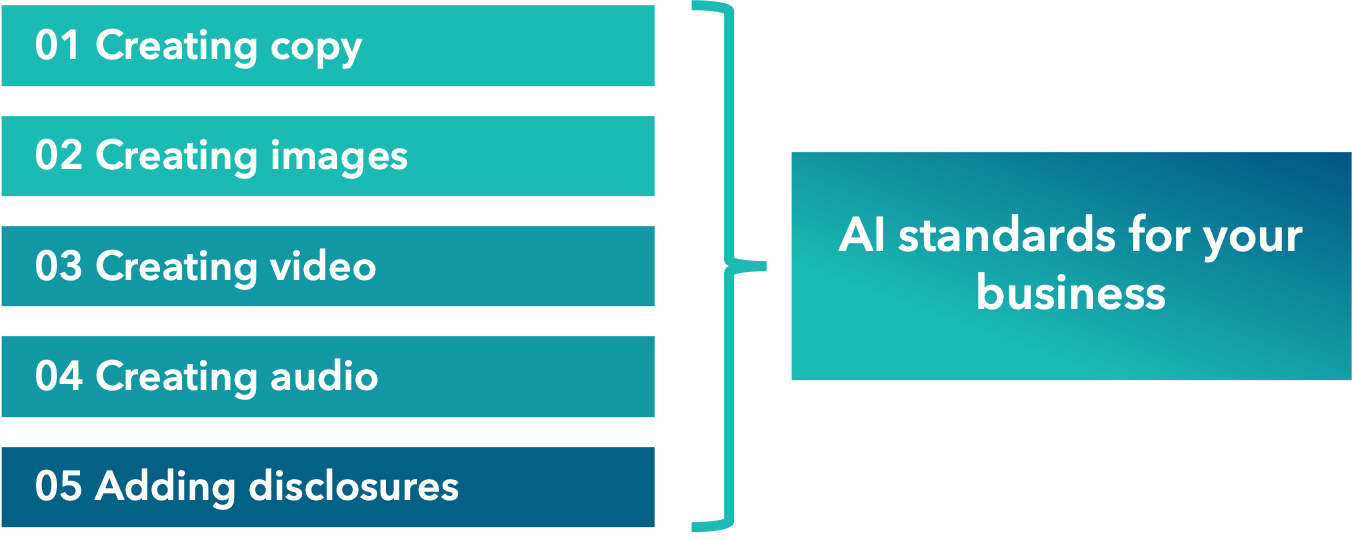
To provide guidance here, we’ve created a framework for organisations to determine AI standards for their business. It focuses on five common areas:
Using working templates like this example:
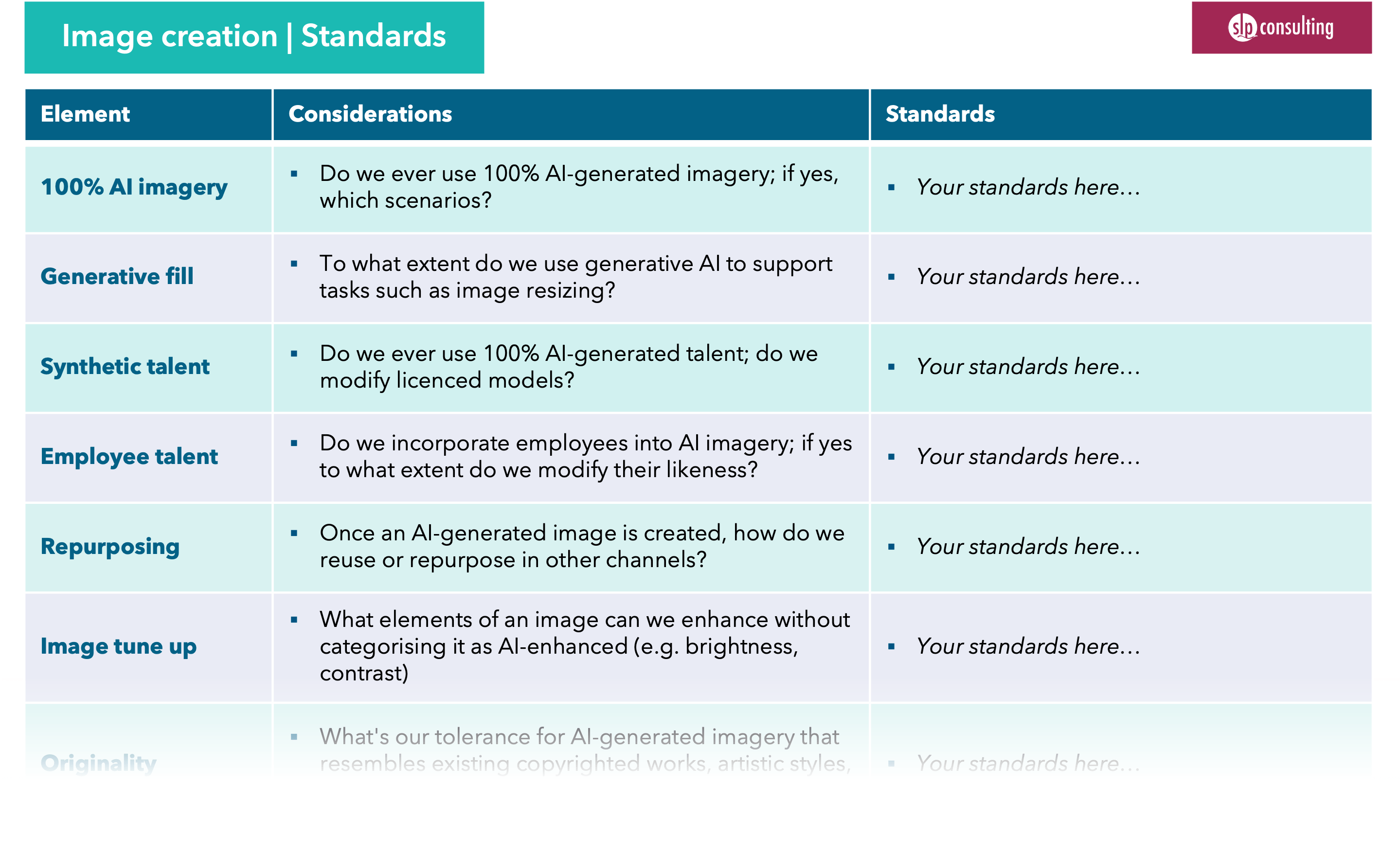
AI standards worksheet example
If you would like to discuss this for your business, please get in touch via simon@slpconsulting.co.uk or 07970 890468.